Santiago
Santiago, the shepherd boy who becomes the protagonist of Paulo Coelho's The Alchemist, is a young Andalusian dreamer who abandons his familiar life to pursue a recurrent dream of treasure near the Egyptian Pyramids, a quest that transforms him into a master of the Language of the World and a living embodiment of the novel's central philosophy: that when a person truly desires something, the entire universe conspires to help them achieve it.
Identity and Background
Santiago is introduced as a shepherd in the fields of Andalusia, a young man who had once attended a seminary until the age of sixteen, studying Latin, Spanish, and theology at his parents' wish that he become a priest. He gave up that path because his desire to know the world was stronger than his interest in knowing God and learning about sin. His father, a simple farmer, gave him three ancient Spanish gold coins found in the fields and his blessing to buy a flock of sheep, and Santiago spent the next two years traveling the Andalusian terrain, learning everything about shepherding: how to shear sheep, care for pregnant ewes, protect the flock from wolves, and know the fair price for every animal. He owns a jacket, a book he can trade for another, and a flock of sheep, and he is able every day to live out his dream of travel. He has already seen many castles and met many women, though none has equaled the merchant's daughter, whom he met in a village and who has made him feel for the first time the desire to live in one place forever.
The Call to Adventure and the Crossing of the Threshold
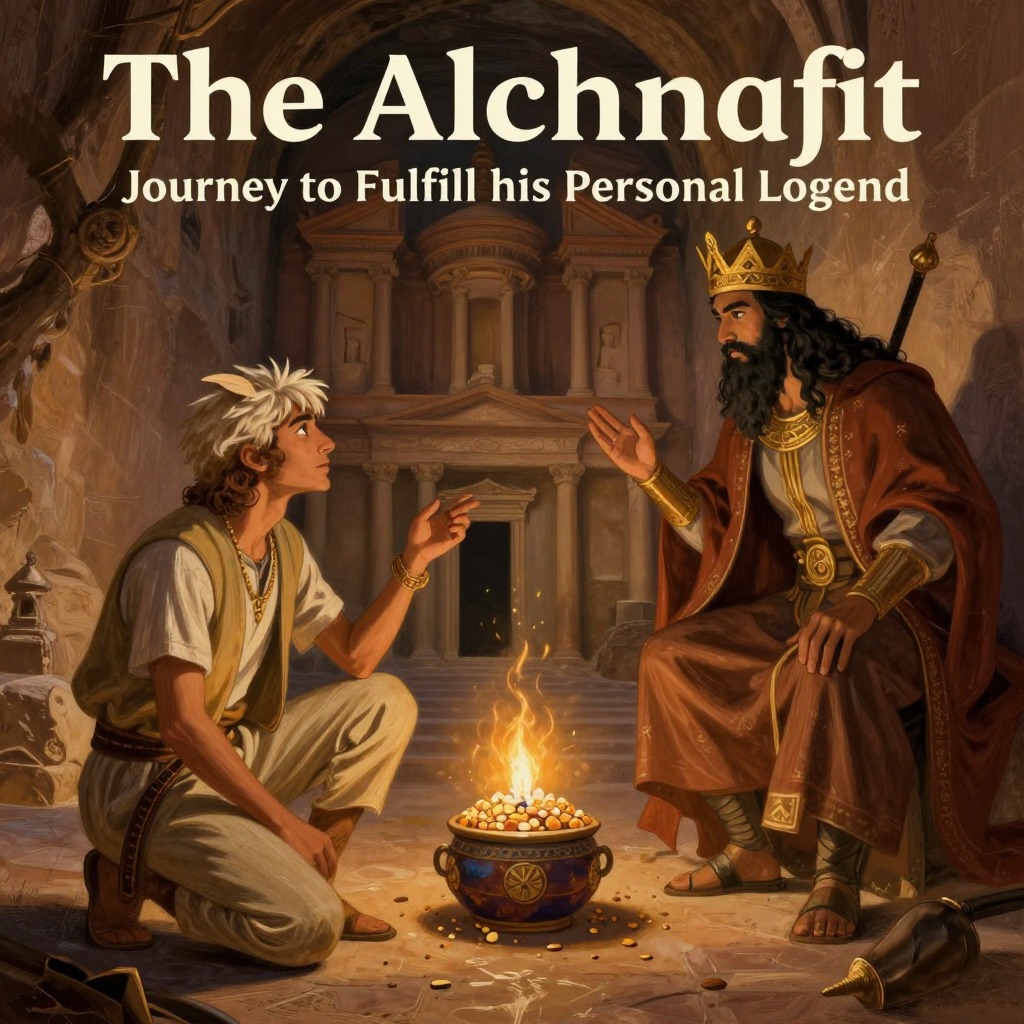
Santiago's journey begins with a recurrent dream: a child appears while he is in a field with his sheep, plays with the animals, then takes him by both hands and transports him to the Egyptian Pyramids, where the child says, "If you come here, you will find a hidden treasure." He seeks out an old woman in Tarifa who interprets dreams, and she tells him he must go to the Pyramids in Egypt, demanding one-tenth of the treasure if he finds it. Disappointed, he decides never again to believe in dreams, but then he meets Melchizedek, the king of Salem, who writes in the sand the names of Santiago's father, mother, seminary, and even the merchant's daughter—things Santiago had never told anyone. Melchizedek explains the concept of a Personal Legend: "It's what you have always wanted to accomplish. Everyone, when they are young, knows what their destiny is." He tells Santiago that when a person wants something, "all the universe conspires in helping you to achieve it," and that the boy is at the point where he is about to give it all up. After a night of struggle, Santiago sells his flock—six sheep to Melchizedek as payment, the rest to a friend who had always dreamed of being a shepherd—and crosses the narrow straits to Africa, arriving in Tangier.
Trials in a Strange Land: Robbery, the Crystal Shop, and the Caravan
In Tangier, Santiago is immediately robbed by a young man who pretends to be his guide, losing all the money from the sale of his sheep. He weeps in the empty marketplace, feeling that God is unfair and that this is how God repays those who believe in their dreams. But he picks up the two stones Melchizedek gave him—Urim and Thummim, which signify "yes" and "no"—and decides to think of himself as an adventurer in quest of his treasure rather than a poor victim. He finds work with a crystal merchant, cleaning glasses in exchange for food, and the merchant, seeing that two customers entered while Santiago worked, takes it as a good omen and hires him. Santiago works for the merchant for nearly a year, proposing a display case to attract customers from the bottom of the hill and later the idea of selling tea in crystal glasses to people who climb the hill. The business expands enormously, and the merchant has to hire two more employees. Santiago saves enough money to buy a hundred and twenty sheep, a return ticket, and a license to import products from Africa, but when he is about to leave, the merchant tells him, "You know that you're not going to buy your sheep." Santiago realizes the merchant is right, retrieves Urim and Thummim from his old pouch, and decides to continue his quest. He joins a caravan crossing the Sahara Desert toward Egypt, where he meets an Englishman searching for the alchemist, and a camel driver who teaches him to live in the present: "If you can concentrate always on the present, you'll be a happy man."
Love and the Oasis: Fatima and the Vision of the Hawks
The caravan arrives at the Al-Fayoum oasis, a vast settlement with three hundred wells and fifty thousand date palms. There, Santiago meets Fatima at a well, and in that moment he feels that time stands still and the Soul of the World surges within him. He learns the most important part of the Language of the World: love. He tells Fatima he wants her to be his wife, but she is a woman of the desert and tells him he must continue toward his goal: "If I am really a part of your dream, you'll come back one day." While sitting in the desert, Santiago watches two hawks flying and suddenly has a vision of an army with swords at the ready riding into the oasis. He reports this to the tribal chieftains, who, after a tense discussion, decide to break the oasis's neutrality and arm their men. The next day, five hundred tribesmen attack an empty tent and are surrounded; all but one are killed. The tribal chieftain presents Santiago with fifty pieces of gold and asks him to become the counselor of the oasis. That night, Santiago meets the alchemist, a mysterious horseman dressed in black with a falcon on his shoulder, who tests his courage by holding a sword to his forehead. The alchemist tells Santiago that he already knows all he needs to know and that he will guide him across the desert.
The Final Tests: Transformation into the Wind and the Discovery of the Treasure
Santiago leaves the oasis with the alchemist, despite his love for Fatima, because the alchemist convinces him that love never keeps a man from pursuing his destiny. They cross the desert for many days, and Santiago learns to listen to his heart, which tells him that the fear of suffering is worse than the suffering itself. They are captured by a hostile tribe, and the alchemist tells the chief that Santiago can transform himself into the wind. Given three days, Santiago speaks to the desert, the wind, and the sun, and finally reaches through to the Soul of the World, understanding that it is a part of the Soul of God and that his own soul is the same. A great simum blows, and when it ceases, Santiago is standing on the far side of the camp. The chief, impressed, lets them go. The alchemist turns lead into gold at a Coptic monastery, gives Santiago a portion, and leaves him. Santiago rides alone to the Pyramids, where he falls to his knees and weeps. He begins to dig where his tears fall, but finds nothing. Refugees from the tribal wars beat him and take his gold. Before leaving, their leader tells Santiago that he, too, had a recurrent dream—of a treasure hidden at the roots of a sycamore growing out of the ruins of a sacristy in a ruined church in Spain—but that he was not stupid enough to cross a desert for a dream. Santiago laughs with joy, understanding the omen. He returns to the abandoned church in Andalusia where he began, digs at the base of the sycamore, and finds a chest of Spanish gold coins, precious stones, gold masks, and stone statues embedded with jewels—the spoils of a forgotten conquest. He places Urim and Thummim in the chest as a reminder of the old king, and feels the levanter wind bring the scent of Fatima's perfume and the touch of her kiss. He says, "I'm coming, Fatima."
Thematic Significance and Narrative Role
Santiago's journey is the novel's central vehicle for its philosophical teachings. He embodies the principle that every person has a Personal Legend and that the universe conspires to help those who pursue it. His transformation from a simple shepherd who reads books to his sheep into a man who can speak to the wind and the sun illustrates the novel's core idea that all things are one and that the Language of the World can be learned through action, love, and attention to omens. His relationships with Melchizedek, the crystal merchant, the Englishman, the camel driver, Fatima, and the alchemist each teach him a different lesson about destiny, fear, love, and the present moment. The structure of his quest—beginning with beginner's luck, undergoing severe trials, and ending with the discovery that the treasure was where he started—enacts the alchemist's teaching that "every search begins with beginner's luck. And every search ends with the victor's being severely tested." Santiago's story ultimately affirms that the journey itself is the treasure, and that the material reward is a symbol of the spiritual growth achieved along the way.